
Apart from the stellar final section, there isn’t a whole lot to recommend in Twilight Zone: The Movie. Two of the four short films are piss poor and one is merely okay.
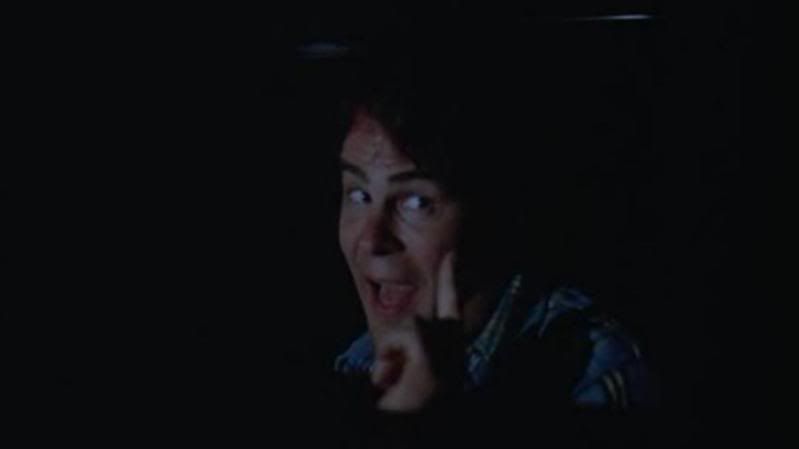
However, the opening prologue is rather amusing. The film begins with two men driving along a deserted road at night. It’s unclear whether the men know each other, but they talk about TV shows and eventually begin to try and scare one another. The driver’s method is to turn the lights off on his car and drive blind. The passenger isn’t best pleased and then asks the driver if he wants to see something really scary. The driver pulls off the road and the passenger turns around. When he turns back he’s a blue demon.
I don’t know whether the above is meant to be scary, but it’s certainly funny. And it’s funny because Dan Akroyd plays the passenger. A less scary man I can’t imagine – he the cuddly, Pillsbury Dough Boy-like figure of the Ghostbusters films. So therefore, when he has the driver (incidentally played by Albert Brooks) stop the car, and when he holds his finger up as he hides his face, it’s amusing rather than threatening. What’s blubber-boy Akyroyd going to do? Hug the man to death? And as a demon he almost does this. But even though the moment with the demon is genuinely meant to be shocking and scary, it’s made somewhat laughable by the fact that the demon looks like it goes cross-eyed when it attacks the driver. The bonk-eyed demon from hell strikes!
Sadly most of the short films aren’t as entertaining as this prologue.
The first short, and the one that was responsible for beheading Vic Morrow and the killing of two children when a helicopter crashed into them, is a moribund affair. What we have is a bigot pissing and moaning about the fact that he was passed over for promotion by a Jewish man. Cue the joyless bastard insulting as many minorities as he can.
For his sins, the man is then transported back to Nazi Germany and he’s recognised not as the all-American, uber macho Yankee he sees himself as, and is instead given a yellow star to wear. He then tires to run away and is pursued by dirty fascists.
After this, he’s transported back to America and is almost lynched (a group of rednecks call him a nigger). However, the man manages to kick a hooded Klan member into a burning crucifix, once again proving why it’s stupid to walk around with a huge, burning stick. And after surviving this ordeal, the man is transported back to Vietnam and is almost killed by American soldiers as they call him a gook.
The final moments see the man transported to a concentration camp by Nazis. Mmm. I wonder what the moral of this story could be? Is it saying that racism is, you know, bad?
The second film, directed by Steven Spielberg, is even worse than the first. Indeed it’s hardly even worth mentioning. Basically what happens is that a magic black man turns a bunch of old codgers into children and we learn that no matter how old you are, you should always stay young at heart. But there can be no feelgood glow when the child actors are so overbearingly precious. It’s like a horrible test run for Hook. And plus it feels incredibly out of place when spliced into the middle of all of these dark, nasty tales. It’s like being punched by a couple of right hooks (Demons! Nazis!) and then someone baking you a cake that makes you puke all over yourself. It’s just wrong.
Things improve somewhat with the third film, but it still didn’t quite do it for me. A schoolteacher almost runs over a child and then drives him home to take him back to his family. However, when we get to his house, we realise something is wrong. The family (which proves not to be his family at all – he ‘collects’ people) behave weirdly and there seem to be far too many televisions playing cartoons.
Over time we find out that the child can make all of his wishes come true. And seeing as he’s a pre-pubescent, he mostly wants to make people cook him burgers and tell him how great he is. Of course, though, for everyone else, this is hell. They live in terror. They’re always frightened of displeasing their ‘son’.
And while this story is fun, the attempts to round out the character of the child fall flat. He’s sad that his wishes don’t make him happy like wishes are supposed to. Oh boo-hoo, I feel so sorry for someone who transports people into cartoons and has them eaten by weird cartoon characters. Yes, I can feel your plight.
And while there are some pleasingly nasty shocks, the end is kind of ridiculous. The teacher decides to become a real mother to the boy and he promises to no longer use his powers for evil – she’ll look after him and give him a proper life. Yeah, right, good thinking lady. You just know that he’ll fall off the wagon. I mean, say he’s okay for a couple of years. Sounds okay, doesn’t it? But then the teenage years will hit and bad things will happen. Just think about it. Say there’s a girl in school that he likes but then she turns him down. Is he really going to accept that? I don’t think so. He’ll do something hideous to her. Or even if he has a girlfriend but she wont perform an act that he desperately wants. For example, say he wants her to perform oral sex on him but she doesn’t like it. He’ll probably go and have her mouth turned into a vagina and have her transported into a maximum security prison. Or alternatively, unbeknownst to her, he’ll have her clitoris transported into her heart. The only time the woman will have a clitoral orgasm will be when she has a massive coronary.
Thankfully the fourth film comes along and blows everything else out of the water. It’s a remake of the Twilight Zone story that had William Shatner terrorized by a fat Yeti on the wing of a plane (a fat Yeti that looked like the man in a bear suit in The Shining - the one that was sucking that ghost dude's cock). Here, though, you have a nasty, evil looking gremlin.
The success of the story lies in the everyday fear that drives it. Even if you’re not frightened of flying, you can relate in some way. I’m sure most people have had their moments on flights when they’ve been scared – whether it be turbulence or a jittery landing. So unlike the demons, the scary boy and the Nazis (unless you lived through the Second World War), you finally have a story that can easily resonate.
Plus there’s no annoying moralising. This isn’t a plea to stop being a bigot, or to stay young at heart, or to be nice – it’s just a good, honest story about a gremlin.
And the gremlin anyway is just a visualisation of the fear that something will happen to the engines or the plane itself. It’s a normal fear made flesh.
And most of the time the gremlin looks very cool. It looks particularly creepy when seen from a distance. But things kind of fall apart when it interacts with John Lithgow. At the end there’s a ridiculous moment when Lithgow shoots through the plane window and man and monster fight at thousands of feet in the air. It’s the only wrong step in an otherwise excellent piece of filmmaking.
Lots of credit must be given to the director and the star. The film is jittery and anxious, and Lithgow’s performance is marvellous. And it’s kind of galling that the director of Mad Max and Babe: Pig in the City could so easily blow Spielberg off the screen. But he does so with ease.
Consider this when deciding whether you want to see Crank: High Voltage. Would you enjoy the sight of a man being penetrated by a shotgun and would you be amused by the ensuing interrogation (complete with twisting of the shotgun in the man’s ruined anus)? If your answer to that question is yes, then you’re my kind of twisted son of a bitch and will love this movie.
Like the original film, Crank: High Voltage isn’t so much a film than it is a passive video game. The plot that links the scenes together is superfluous. It’s only there to link a series of outrageous sketches together.
It would be easy to write High Voltage off as mindless trash, but that would be to miss the insane wit that is contained within. Honestly, there’s more imagination here than there are in the best reviewed, most widely acclaimed movies. The filmmakers have pilfered from cartoons, video games, action movies and slapstick and produced one of the most entertaining films you’ll see. This isn’t a film made by knuckleheads – it’s made by a couple of insane geniuses.
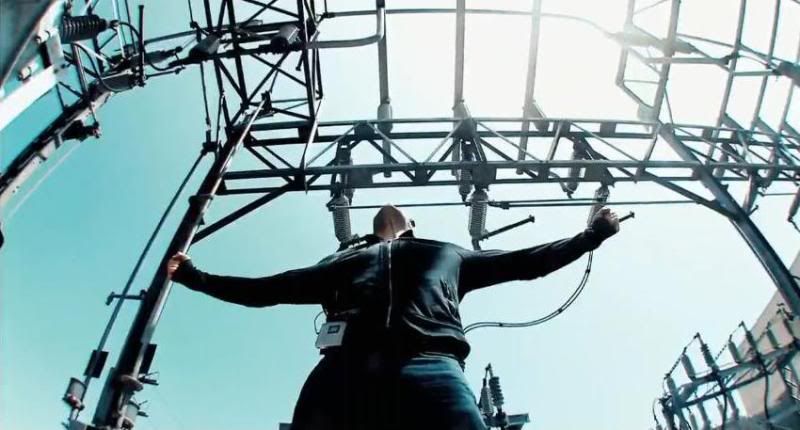
The bit that convinced me that I was watching a film made by comedy geniuses was when Chev (Jason Statham) confronts the man who has stolen his heart (long story short: Chev survived the helicopter fall in the first film, had his heart removed and a mechanic one installed, and now needs to shock himself with electricity to keep it working). Chev’s energy is running low but he’s conveniently run into an electric plant. So he shocks himself and the film then goes crazy. The frame distorts and we have the sight of a couple of stuntmen in bad masks of the actors fighting a Godzilla-style fight on a small recreation of the electric plant – the men crush buildings as they scrap. There’s no real reason for this insane flight of fancy, but it does the trick – it had me laughing like a spazz.
Another moment of inspiration is the way that an action scene is interrupted to have a dialogue scene with a minor character in the original film. The man in question had a gun pointed at his face by Chev and subsequently suffers from anxiety issues. However, a MILF psychiatrist cougar who wants to fuck this poor guy, works her magic and convinces him that life is worth living. But then when he stands up, a stray bullet enters the office and goes through his brain. You’ve got to admire the time and care the filmmakers take to build a joke.
I also like the way that the film stops so that it can show Chev’s childhood via his appearance on a tabloid chat show. The young Chev appears quite mild mannered at first but then we cut to him beating the shit out of playground bullies. And it’s brilliant the way that the filmmakers don’t try and disguise the fact that Chev’s childhood is filmed in America. I mean, you have British Bobbies and red telephone boxes but the buildings and the sky are pure California. And amazingly, it proved to be an inspired choice to cast Geri Halliwell as Chev’s mum. As anyone who has seen Spice World or her cringe-worthy appearance in Sex in the City can attest, the woman has not one iota of talent. Her attempts at acting are enough to break even the toughest individuals. Five minutes of her (sometimes even thirty seconds) will have you looking for the nearest shotgun to penetrate yourself with. But here she’s really quite amusing. (However, I do think that the filmmakers missed a trick by not having Chev appear on the Jeremy Kyle Show – that would have made it even better.)
However, as ingenious as High Voltage is, towards the end you feel that it’s running out of surprises. I mean, sure testicle torture is amusing and all, but you know that the film can do better. And eventually it does. At the end the main bad guy reveals why he’s so pissed off – Chev killed his brother in the first movie. But not to worry, the bad guy’s brother isn’t actually dead. His head is being kept alive in a tank. Pretty much all the head can say is ‘Fuck you, Chelios’ (and in a Stephen Hawking voice), but at least he’ll be able to witness Chev’s death. Words cannot state how much this amused me. A man killing another man because his brother can now only be a head in a tank? Again this is another example of the filmmakers’ insane imagination.
The final action sequence is as mad as you’d hope. Chev eventually smashes the tank that contains the head, and, after it asks him for water, punts it into a swimming pool. And then almost as crazily, Chev electrocutes himself on some power lines and finishes the film in flames while giving the audience the bird. Will anything kill this man? Happily the answer to that is no. And the sight of a burnt-to-a-crisp Chev still alive and fairly well gives me hope for a zombie Chev film. That would be awesome.
Speaking of awesomeness, the obligatory sex scene in High Voltage exceeds the one in the first film. You see, Chev needs to build up some static electricity in order to keep his mechanical heart pumping. At first he tries to rub up against a guy (a gay punker Bono lookalike) but then he finds an immobile old lady. He frottages the shit out of the old biddy until Chev’s girlfriend turns up. She’s appalled, but within a matter of moments Chev and his girlfriend are on a racecourse fucking in front of thousands of people. We see various crazy positions, but just when you think you’ve seen this all before in the previous film, a bunch of horses jump over the couple and we see a series of horse cocks. Yes, apparently Chev is hung (as we’re told over and over again) – no wonder untrustworthy Asians would go to all this effort to harvest his marvellous organs.
P.S. – watch the fight with the cops. Chev’s reenergising and subsequent one blow, six man destruction would make John Matrix proud.
I should hate Crank. After all, it features hyperactive MTV-style direction, a ridiculous plot and bad acting by the ton. But instead I ended up enjoying it a great deal. It's a film that knows it's trash and just wants you to have a good time – plot and character are unimportant.
The reason why the film succeeds so triumphantly is because of the film's wicked sense of humour. The central conceit – that a man is poisoned and has to keep moving to stay alive – is a just a vehicle to bring about a group of preposterous situations, all of which had me grinning like a loon.
The scene that had me laughing hardest was when Chev (Jason Statham) chops a bad guy's hand off with a meat cleaver. Fair enough, that doesn't sound that funny in itself, but there's a genius bit where the guy, with a stump now for a hand, tries to punch Chev in the head. Chev moves and the guy's stump slams into the concrete floor with a meaty thud. Brilliant! And even better, Chev finally kills the guy by picking up his chopped off hand, which is still clutching a gun, and shoots him. Violence has never been so ingenious, or as funny.
Another inventive piece of violence occurs when Chev goes to pick up his girlfriend at her apartment. Little does she know that some bad guys are on the way to kill her, but without her even realising – the phone rings and then later the contents of her handbag get thrown to the floor – Chev takes them out. It's a wonderful bit of comedy, kind of like something Buster Keaton would have done if he'd been into guns. The timing is perfect. And there's also a great bit where an old woman's budgie gets blown away as Chev is wrestling with a guy over a silenced handgun. If that doesn't make you laugh you're dead inside.
You're also dead inside if you don't laugh at the idea of someone having to fuck to stay alive. Honestly, the public sex scene is a delight. Everything from the initial failure to get it up, the arse slapping and the triumphant moment when Chev takes his girlfriend from behind as everyone watches and as he cheers, 'I'm alive!' had me in stitches.
I also liked the scene where Chev gets a blow-job in the middle of a car chase. It's no less silly than all the other stupid scenes where characters get the horn in action films and have sex in inappropriate places, but the difference here is that it's done with a nod and a wink. You know it's silly and the filmmakers know it's silly, but the complicity allows you to laugh along with the film rather than at it. And with lines like 'Jesus, you're so big' thrown in as Chev gets blown and kills people at the same time, you can't help but admire the filmmaker's insane commitment to producing a film that perpetually stays in the realms of bad taste.
However, as funny as the chase scene is, there was a moment that made me cackle even harder. There's a bit where Chev, high on epinephrine, and clothed in a hospital gown, runs through town. He stumbles upon a news report concerning his antics, which is watched by a growing crowd. At first no one notices him, but then a man looks over, and then looks down, and because of the drugs Chev is on he's confronted by the fact that he has a massive boner. The glower that Statham gives the guy is perfect.
Yet another scene that had me laughing my arse off: Chev is in a taxi and is slowly beginning to pass out. To wake himself up he gets the Arab cab driver to turn the radio up. Chev then starts head-banging to 'Achy-breaky heart'. And then after robbing a store and filling a bag full of energy drinks, he hurls the cabbie to the floor and shouts, 'Al-Qaeda'. Suddenly a bunch of old fogies leap on the poor guy and begin breaking limbs. Honestly, people who call this a dumb piece of crap are deaf and blind. This is one of the most inventive, witty and gleeful action films I've seen in years.
But unfortunately most people seem to be blinded by the violence, sex and bad taste jokes. Plus there are numerous references to computer games – it owes a large debt to Grand Theft Auto, what with its frequent top down views of the city, cheesy graphics and characters who can survive masses of punishment and keep going. Therefore it's been tagged as empty-headed drivel. But instead it's a playful jab at action movie clichés and conceits whilst also acknowledging how fun they are. It's like Speed but without the po-faced attempts to build character and supply emotion. This film, what with its 'medicinal' coke snorting, public sex and gratuitous violence, is only interested in the gut. It wants to make you laugh and wants you to get caught up in the excitement. And for me it worked superbly. After all, any film that has a scene where a man shocks himself with a defibrillator to get out of a shootout and to keep his achy-breaky heart going, has got to have something going for it, hasn't it?
Like Quentin Tarantino says in Sleep With Me, Top Gun is a gay film. How gay? Put it this way, it's gayer than an oiled wrestler doing the worm in a bed of pink feathers with chocolate sauce smeared across his tanned buttocks. We're talking super gay.
One of the few enjoyable things about watching this horrendous film is listening to the dialogue and laughing at the double entendres. Virtually every line contains some sort of gayness. Just take the classic "He's on our tail, coming hard". Speaks for itself, doesn't it? But then there's, "Just stay on my wing and I'll take you all the way in". Ostensibly this line is about Maverick helping a rattled comrade land his plane, but really it's about Maverick helping a colleague make a different kind of landing – one that's just as delicate.
However, other lines aren't so subtle. One of Maverick's commanding officers (Strickland out of Back to the Future) says, "I want to bust your butt, but I can't." Obviously this individual is suffering from some sort of erectile dysfunction. But another officer doesn't suffer from this affliction because at one point the said individual roars, "I want some butts!" He says it loud and proud.
But then there are the simmering tensions between the pilots. They obviously all fancy one another. I mean, one pilot even confesses to his colleague that all this flying jazz gives him a hard-on. But rather than quietly moving away or laughing a polite laugh, the other bloke tells his pal not to tease him. You just know that as soon as they had some privacy they had their hands all over their joysticks.
But this is nothing compared to the unspoken longing between Iceman and Maverick. They start off by giving each other flirty glances and by exchanging catty comments (Iceman is such a bitch!), but soon they're talking about their privates and arguing while wearing nothing but towels. The obvious outlet, at best, would be sweet, hot sex, but since they're still struggling with their feelings – Maverick is loyal to the end to Goose (his wingman) – they engage in a game of volleyball. Needless to say there are ripped torsos aplenty and everywhere you look there are high fives and slapped bums. But on top of that you have Slider flexing his muscles to a song that's called 'Playing With The Boys'. I'm sure many confused young men (and quite a few that aren't confused) have worn out their old VHS copies of this film by endlessly rewinding and pausing that scene.
But this volleyball scene has other implications. Because of his homoerotic posturing on the beach, Maverick misses a date with Kelly McGillis (who actually plays a character who calls herself 'Charlie' – I bet Maverick would rather choke on Iceman's joystick than call her Charlotte). But it's unclear whether he genuinely has feelings for her. He seems sort of interested, curious even, but he leaves before they can have sex. And like Tarantino says in Sleep With Me, how does she get him interested again? By dressing up like a man. After that she finally becomes Maverick's beard. And they even have sex. But Maverick can't even have straight sex in a heterosexual manner. Rather than cock his missile and fire some bombs, he probes his target tenderly while curtains billow and 'Take My Breathe Away' plays. He's yearning for the boys.
And the music is another clue. Not only do you have 'Playing With the Boys' and 'Take My Breathe Away', but you have 'Danger Zone', a song that features the lyric 'Take you right into the danger zone'. On the surface the song is talking about the risks that are taken by jet pilots, but it's really an ode to anal sex.
And Maverick's true feelings are revealed further when Goose dies. He reacts like he's lost a lover. He even quits his job. But when McGillis tracks him down, she's disgusted at what he's become – a man that has finally lost that cocky smirk. Personally, I don't know what her problem is. Before the accident, Maverick is unbearably smug – the 'You've Lost That Lovin' Feeling' scene is probably the most odious thing in cinema – but afterwards he's close to being something like a human being.
But alas the death of Goose has no emotional impact. It's just a cynical way of giving a very thin film a third act. After all, rampant gayness aside, the movie has no content. Maverick goes to Top Gun, meets a woman who resists him for about two seconds, and battles with a gay colleague in some nicely filmed but very uninvolving flying scenes. There's nothing to the film. It's as shallow as it gets.
And the final action scene is pure desperation. The filmmakers finally cotton on that in the absence of a well-written film with three-dimensional characters what we want to see are planes being blown to bits. And yeah a few planes get blown up and it's well filmed, but unfortunately the wrong people die. I wanted the Russians to win. And I wanted them to win for the same reason that I wanted the Japanese to win in Pearl Harbor. In both films the Americans are portrayed as oversexed jackasses that can barely utter a single sentence without hooting and hollering. They're obnoxious. The Russians, though, are completely professional. They don't talk; they just fly. Obviously this is meant to make them seem sub-human (and the black visors are meant to make them look evil), but give me a malevolent atheist who can fly his penis extension with skill and composure over a loud-mouthed, flag waving, god fearing, freedom loving, sexually confused American any day of the week.

A film like Paris, je t’aime was always going to be hit and miss. Consisting of 18 short films, each tries to tell a Parisian love story in about five minutes. It goes without saying that some of the films are charmers and some are absolute dross.
Okay, so let’s get the crap out of the way first. What are the stinkers?
The film that immediately springs to mind is Porte de Choisy by Christopher Doyle. Concerning a beauty product salesman in Chinatown, it doesn’t have one moment where it doesn’t annoy, frustrate or enrage. It’s the work of someone with a million ideas but someone who doesn’t know how to tie them all together. So therefore we have to suffer random nonsense like fists shooting through windows, Asian women prancing about in blonde wigs and minimalist dance routines. It’s an appalling pointless film, and I can’t imagine why it was included in the movie – it adds nothing to the piece.
Next on the shit-list is Tour Eiffel. Twee, cloying and sickeningly cute, it tells the story of a mime who falls in love. But this mime isn’t an ordinary man – he’s a man who was literally born a mime; he can’t remove the make-up. This short encompasses everything that is bad about French comedy – everything is about silly faces and cute visual gags. It’s meant to be loveable and endearing, but it ends up being creepy and vomitsome. Two mimes falling in love? Yeah, we don’t need mimes breeding.
Another monumental failure is Quartier de la Madeleine. Here we have Elijah Wood encountering a vampire in a deserted street. But even though he encounters the vampire while backpacking at midnight, rather than run away, he slits his wrists and offers himself. Cocking Christ Almighty, what an idiot. Ooh, that French vampire with her milk bottle skin is tres sexy. I’d like her to give me toothy blow-jobs for eternity. But at the end the two nibble on each other and fall blissfully in love. Too bad Paris hasn’t got any Hot Topic stores – even though this film sucked balls, a movie with them slaughtering annoying tweens might be quite amusing.
Among the more successful stories is Tuileries, a film by the Coen Brothers. It details the experiences of an American tourist (played by Steve Buscemi) as he consults his tourist guide and as he watches a young couple from the opposite side of a Metro station. It’s a film that uses the medium to its advantage – dialogue is sparse and the action is restricted to one location. It’s not overwhelmingly clever or funny, but it never outstays its welcome. And it also captures a couple of universal truths – the outsider feeling you have as a tourist and the resentment that bristles inside locals when they spot someone who’s not one of them.
Another minor triumph is Bastille, a story about a man who is about to dump his wife when he finds out that she has cancer. The expected punchline in a short film about this subject would be that the woman was lying about her illness and just wanted to make sure that her husband didn’t leave her. But instead you have a sad little film about devotion – the woman dies and you get the feeling that the man will never recover.
An even bigger tearjerker than this is Place des fetes. It’s about a Nigerian man who, as he lays dying in the road, asks a paramedic for a cup of coffee. We then find out that the man had fallen in love with the paramedic at first sight at an earlier point in time. Again, it works because it’s simple and because it doesn’t throw a million different ideas at the screen.
Contrast this with Faubourg Saint-Denis. Directed by Tom Twyker and starring Natalie Portman, we have a blind man recount the story of a doomed love affair. It’s far too ambitious a story for a five minute film and at the end there’s a confusing payoff. As a consequence you’re left scratching your head.
However, there is one film that’s ambitious and which succeeds in producing marvellous results. That film would be the last one – 14e arrondissement. Alexander Payne’s film tells the story of a middle-aged Denver woman who goes abroad for the first time. She tells her story in fluent French but with a hideously bad accent. But like most of Payne’s films, while you begin the film laughing at the character, you end up sympathising with them. This woman, all alone and desperately trying to reach out, tries her hardest to experience something new. And so what if her accent sucks? You end up feeling extraordinarily pleased that she’s come to love this city and that her holiday has proven to be worthwhile. Too many tourists want to go somewhere and then put no effort into their holiday. Therefore this woman’s effort and success is moving and triumphant.
The fact that the film concludes with this short perhaps gives the film a better ending than it deserves. With the exception of the Payne short, what we have here is, by and large, either ordinary or poor. And while it’s always nice to see Paris filmed with such love and care, you never really feel like you’re getting to know the city. I guess I’ll just have to go there myself one of these days.
Blindness is a film that was reviled by the majority of critics. Everyone seemed to agree that it was worthless. And because of this, I ended up avoiding the movie when it was released in cinemas. My reasoning was that surely this many people couldn’t be wrong.
Well, they were. Fernando Meirelles’ film is tough and uncompromising, but it isn’t the cinematic atrocity that people have tarred it as.
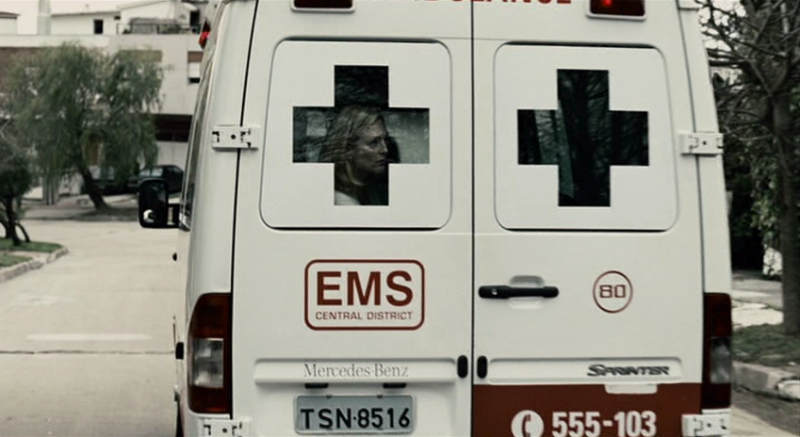
The story revolves around a mass outbreak of sightlessness. Person after person becomes afflicted until eventually the government has to declare a state of emergency and herd the blind people into a few hospital wards in order to try and contain the unknown disease.
One of the first people to be quarantined is a doctor (Mark Ruffalo). Joining him is his wife (Julianne Moore), who actually feigns blindness in order to be with her husband. And even though the disease/infection/outbreak spreads throughout the whole of society, she seems immune.
We never know why she doesn’t succumb; we’re never given an explanation. But being the one person that can still see, she gets to witness the breakdown of society.
Some people have claimed that the depiction of blind people in this film is offensive. This is ridiculous. The film has nothing to do with the sightlessness that afflicts people in the real world. This film is about the chaos that ensues when people can no longer share another person’s point of view. In this film that is taken literally, but in Blindness you can see echoes of real life. One example that springs to mind is the craziness that happened in Germany during World War Two. Not everyone who committed atrocities was a monster. Many of them were perfectly ordinary people, but because they were caught up in this wave and because they could no longer see someone else’s point of view (or were allowed to), they performed heinous acts. So therefore Moore’s character might represent the person/country/society that is faced with an overwhelming social crisis – how they respond will define them.
As you’d expect, when two hospital wards begin squabbling over food, Moore tries to negotiate. But when this proves to be pointless, Moore buries her head in the sand. Again I’m inclined to drawl parallels with World War Two. The British tried negotiating with the Nazis and then later they curled up into a little ball. Well, until the Nazis invaded Poland...
Moore snaps during the film’s most brutal scene. You see, you have one ward that is run by the doctor and his wife and another that is run by a genuine blind person (someone who was blind prior to the outbreak) and a ‘King’. The ward run by the King takes the food that the government occasionally sends their way and then makes the rival ward pay for the grub. At first the people in the doctor’s ward pay with valuable possessions (again, like in a concentration camp, people are stripped of their belongings – they’re stripped of their individuality), but then the king ups the stakes by making them pay with their women.
Initially, Moore goes along with the plan. After all, they need food, so they should just go along with it, right? But when one of the women is killed, something inside her snaps.
This brutal act draws a line in the sand. Moore can take blackmail and she can suffer personal humiliation, but the casual violence that is inflicted upon a defenceless woman is too much. She intervenes with ruthless efficiency.
Moore waits until the next mass rape and then kills the King, saying that things are different now. From now on, she’s collecting food from Ward 3. If they don’t pay, she’ll keep on killing their men. It’s a vicious response, but it’s pretty much the only course of action available to her if she wants to survive.
As the only sighted person, Moore has a heavy weight on her shoulders. She’s almost a godlike figure, able to pass judgement on those around her and smite them with relative ease if she so chooses. But with her husband, we see what happens when you’re in a position of power and everything is taken away from you. He resents having to be treated like a baby and hates losing his independence. He even cheats on his wife because he feels so inferior to her. The natural instinct, when the world is turned on its head, is to fight and thrash and lash out. It takes a lot of strength to keep things together.
And despite the film’s supposed ugliness, I found it to be quite an uplifting movie. A small group leaves the hospital (the guards who control the outside of the building abandons it, presumably after having gone blind themselves) and makes its way back to the doctor’s house. There they live together and look after one another. This is the sort of response that one would hope would develop in a mass crisis. You’d hope that people would pull together and look out for one another. And the fact that these people do this ends the film with a note of optimism. There’s no need for us to live in a manmade hell.
However, the ending does raise a question. At the end, a man mysteriously regains his sight. Does this mean that everyone else will, too? The way that we see Moore gazing upon the city from her balcony would indicate this. But does that mean that everything will return to normal? That people will go back to their normal ways; that this happy group will separate? Does it mean that after temporarily gaining some form of clarity, laziness and neglect will return to this society? Does it mean that we’ll return to our more regular form of blindness? Most probably, yes.

